Ovulation Calculator
Find your fertile window and ovulation date. Plan pregnancy or understand your cycle better with accurate predictions.
How to Use the Period Calculator
Enter Your Last Period Date
Input the first day of your most recent period in the Period Calculator. This is the starting point for all cycle calculations.
Set Your Cycle Length
Enter your average cycle length (typically 21-35 days) in the Period Calculator. Our algorithm uses this to predict your next period accurately.
Add Period Duration
Specify how long your period typically lasts (usually 3-7 days) in the Period Calculator. This helps predict the menstruation phase.
Get Your Predictions
The Period Calculator calculates your next period, fertile window, ovulation day, and PMS dates based on medical research.
Understanding Your Monthly Rhythm
Most people think of their cycle as just the days they are bleeding, but your body is actually moving through a sophisticated, three-part biological journey every month. Understanding these shifts is exactly why a precise Period Calculator is about more than just 'day one'—it's about mapping your unique hormonal landscape. Our Period Calculator helps you track every phase of your menstrual cycle with precision.
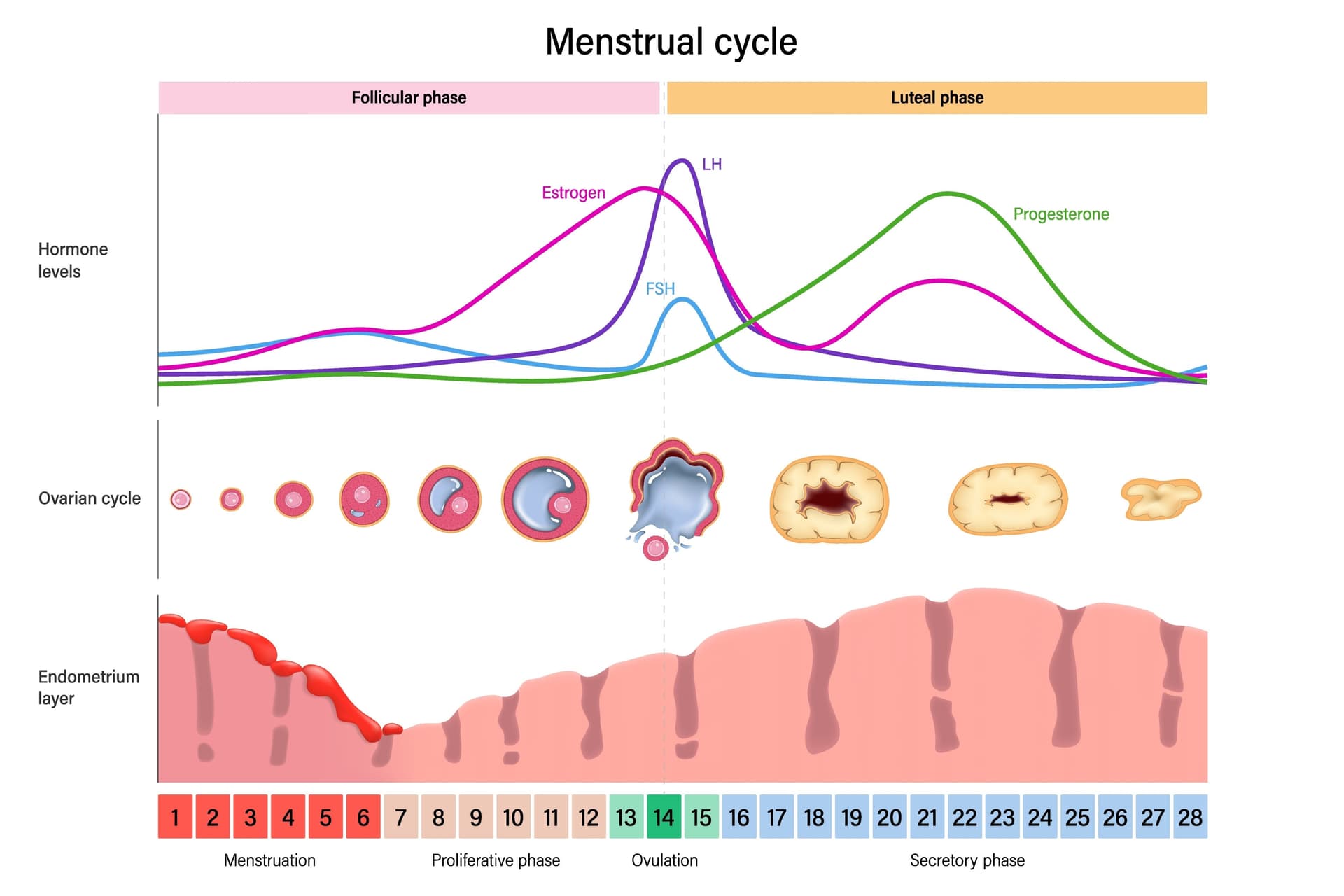
The Follicular Phase: The Buildup
The Follicular Phase begins on the very first day of your period and lasts until you ovulate. During this time, your body is busy maturing an egg for release. As your estrogen levels gradually climb, you might notice a steady boost in your energy, mood, and even skin clarity. By tracking the start of this phase in our Period Calculator, the algorithm begins to learn the specific 'tempo' of your body's preparation. The Period Calculator tracks this phase to provide accurate predictions.
Ovulation: The Main Event
Ovulation is the brief but vital window—usually lasting only 12 to 24 hours—when an egg is released from the ovary. This is your peak fertility window. Because factors like stress, travel, or sleep can shift your ovulation date, relying on a simple average isn't always enough. Our Period Calculator analyzes your historical data to help you pinpoint this window, whether you are trying to conceive or simply want to stay in tune with your body's signals.
The Luteal Phase: The Countdown
After ovulation, you enter the Luteal Phase. This is the 10-to-16-day stretch where progesterone takes center stage, thickening the uterine lining. If you've ever wondered why you feel more sensitive or bloated a week before your period, this phase is the reason. A consistent Period Calculator helps you predict exactly when this phase begins, so you're never caught off guard by PMS or the start of your next cycle.
Frequently Asked Questions
A period is generally considered "late" if it hasn't arrived within five days of your expected start date, according to the American College of Obstetricians and Gynecologists (ACOG). However, since few people have a perfectly rhythmic 28-day cycle, it's normal to see slight fluctuations of 2-7 days. If you are sexually active and your period is even one day late, the most reliable next step is a pregnancy test, as our Period Calculator provides an estimate based on averages, not biological certainty. Source: ACOG Guidelines.
To find your next start date, you first need to identify "Day 1" of your last cycle. This is the very first day you noticed a steady flow. From there, add your average cycle length, which is the number of days from the start of one period to the start of the next. For example, if your last period began on March 1 and your average cycle is 28 days, your next period is predicted to start on March 29. According to NHS UK, most menstrual cycles range from 21 to 35 days.
The "safe period" refers to the days in your cycle when you are least likely to conceive, typically at the very beginning and very end of your cycle. To calculate this, you must first identify your ovulation window, which is usually 12 to 16 days before your next period, according to ACOG. However, it is important to remember that the "Calendar Method" is not 100% accurate. Sperm can survive inside the body for up to five days, making it risky to rely on a calculator alone for contraception. Source: ACOG and NHS UK.
It is quite common for a period to arrive a few days early. According to research published in Women's Health Issues, this usually happens because ovulation occurred sooner than usual. Common triggers for an early cycle include high levels of stress (35% of cases), significant changes in your sleep schedule, intense new exercise routines, or even recent travel. If your period is consistently early (more than 7 days) or accompanied by unusual pain, consulting a healthcare provider is recommended.
The average person loses between 30 ml and 80 ml of blood over the course of their entire period, about 2 to 5 tablespoons, according to ACOG. In practical terms, this means soaking through a pad or tampon every 3 to 4 hours. If you find yourself needing to change your protection every hour or noticing clots larger than a quarter, your flow may be considered heavy (menorrhagia), and you should seek medical advice. Source: American College of Obstetricians and Gynecologists.
Because most people don't know the exact moment of conception, medical professionals use the Last Menstrual Period (LMP) as a clear, objective starting point, as recommended by ACOG and NHS. Since ovulation usually happens about two weeks after your period starts, this means that during the first two weeks of a "40-week pregnancy," you are not actually pregnant yet. This standard helps doctors more accurately estimate your due date and track fetal development milestones. Source: ACOG Practice Bulletin.